
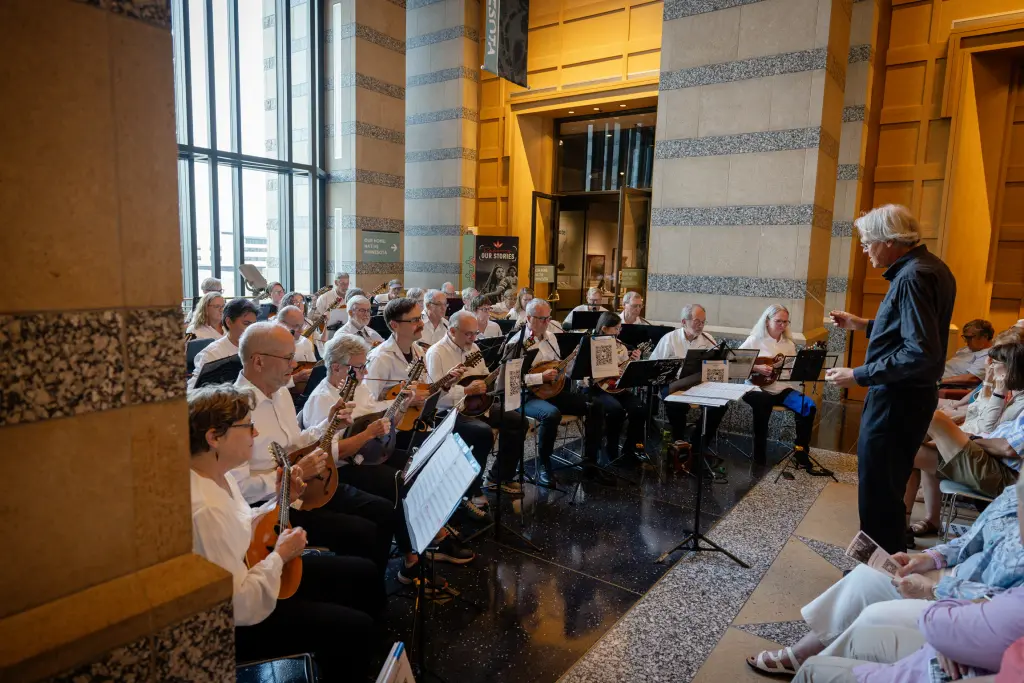
We're thrilled to perform in the Minnesota History Center Great Hall. We have a mix of contemporary and historic tunes selected by our conductor and artistic director, Lon Hendricks, to match the majestic venue we share with you tonight.
We have an exhibit of antique and locally crafted mandolins behind the main seating area by the balcony staffed with enthusiastic experts.
- New York Ideal March (1921)
- We kick off our first set with this banger from Samuel Siegel making hay from his mandolin-orchestra classic, "Boston Ideal March." Believe it or not, a mandolin craze swept the U.S. from the late 1880s through the 1920s, inspiring many communities to form mandolin orchestras, whose repertoire included marches like this one. You can check out the vibe of the era and see a simpler arrangement in the July-August, 1930 edition of The Crescendo, courtesy of the Digital Guitar Archive.
- Waitin' on the Julia Belle (2018)
- Our dear friend John Goodin wrote this tune to commemorate American folk composer, singer, and instrumentalist John Hartford, who worked many summers as a pilot on the steam-powered paddle-boat Julia Belle Swain.
- Lina Peláez Hayes/Asturias (2026)
- This edition of Sherry Ladig's annual composition for our orchestra is dedicated to early-childhood education leader and innovator Lina Peláez Hayes who lives with her husband Martin of the Martin Hayes Quartet in a mountainous region of Spain where Galician and Celtic musical roots intertwine.
- The Wild-Eyed Moose Tango (2022)
- Glen Newton, in our mandola section, wrote this tune about the "dance" in his daughter's front yard in Alaska between two bull moose vying for the attention of an eligible cow moose.
- Waterworks (c. 2017)
- The final vignette "The Village of the Water Mills" from "Akira Kurosawa's 1990 classic Dreams inspired Mark Linkins to compose this tune presenting flowing textures of a simple life powered only by watermills and sunshine. In the film, a traveler stumbles upon a village whose residents eschew modern technology in favor of a simpler life. During the visit, the traveler learns of the villagers' joyful celebrations of life to commemorate the passing of the departed.
- Veritas Vincit (c. 1920s)
- Dutch composer, Johan Kok (1889-1954) wrote more than 200 compositions for mandolin orchestra, many of which aired on Radio Hilversum in the Netherlands during the 1930s and blend popular European folk styles with modern classical music. We hope that the translation of the piece's title "truth conquers" echoes with you in the Great Hall.
- Please Please Me, I Want to Hold Your Hand, & Ob-La-Di, Ob-La-Da (1963, 1963, 1968)
- It's an unwritten bylaw that every Minnesota Mandolin Orchestra performance feature a Beatles tune. Here medley of three of them arranged by our conductor, Lon Hendricks.
Intermission: Get up, stretch your legs, visit the bar, but be back soon, because we have another set for you in 5 minutes!
- The Battle Royal (c. 1912)
- Here's another example from the "mandolin-craze." Our version of Thomas Allen's march appeared in a 1912 edition of The Cadenza magazine. For the uninitiated, the roadmap of many marches from the era follows:
- A brief punchy intro sets the tempo.
- A first strain presents melody to grab the listener's ear and is repeated once.
- A second strain riffs on the melody from the first, providing contrast in harmony or dynamics, and is also repeated.
- The trio section changes to a softer feel with a key change up a fourth from the strains.
- If you've been lulled by the trio, look out. The next section, often called the dogfight, will add excitement with tense, aggressive rhythm.
- The tune concludes by restating the trio.
- Gloriana (1910)
- A.J. Weidt (1866-1945) directed the Newark Mandolin Orchestra and wrote this overture, first appearing in a 1910 edition of The Cadenza, featuring flute solo from Allison, normally in our mandola section.
- Funeral March of a Marionette (1872)
- The next section of the program should be titled "Lon Hendricks Presents" as the orchestra presents pop TV and cinema repertoire. French romantic composer Charles Gounod composed the first episode of our series, which tells a story of a puppet's death in a duel, subsequently being carried by his friends as part of an interrupted funeral parade. The tune briefly switches to a major key as the parade stops at the bar for a drink. You might have countless other creepier stories than that one associated with this tune.
- Lara's Theme (1965)
- Maurice Jarre won the 1965 Oscar for Best Original Score in Doctor Zhivago featuring the "Lara's Theme" leitmotif we perform here. In the movie, a balalaika carries the melody, which the mandolin bears some resemblance to. You might also be familiar with the 1966 song "Somewhere, My Love," which reuses the same melody.
- Where No Mandolin Has Gone Before
- This tune riffs on Alexander Courage's theme for the original Star Trek TV series. Feel free to whistle along if you are so inspired.
- When the arrangement was first performed by the Nashville Mandolin Ensemble in the 1990s, its title carried some veracity, but in the context of prequels and a franchise that frequently uses time travel as a hook, the storyline is bound to change. In Strange New Worlds, a prequel to Star Trek, Christopher Pike, the Enterprise captain preceding James Kirk, plays the mandolin. Anson Mount, the actor portraying Pike, keeps a mandolin in his dressing room to play during downtime on the set.
- Fat Boy Rag
- OK, we're (almost) done with nerding out. Our finale is Bob Wills and the Texas Playboys' 1946 hit "Fat Boy Rag," featuring several solos, including on harmonica by Steve from our second-mandolin section. We promised we were almost finished nerding out – the Texas Playboys' recording of the tune is widely credited as being one of the earliest recorded examples of guitar distortion and fuzz tone in popular music.
Thanks for hanging in there with us. It's always a joy to come to the History Center to perform our craft. Keep an eye out for updates to our schedule and our Facebook page for future performances. Thanks to Mahsima Alkamooneh for the title image above.
Of special note, we'll be performing Friday, November 6 at the annual Classical Mandolin Society of America's annual convention at the Minneapolis Airport DoubleTree hotel. The admission is free and Chris Acquavella will follow our performance with solo mandolin and mandola performance of material ranging from Raffaele Calace to Chris' own original classical compositions.